I’ll say this upfront: every answer I found about the pyramids seemed to open the door to two more questions. So yes, fair warning, this might send you down the same rabbit hole…
Over the years, people have come up with all kinds of explanations for how they were built. Some say enormous ramps were used to drag the stones upward, others suggest wooden rollers, water-soaked sand to reduce friction, or elaborate causeways stretching across the desert.
All of them sound almost convincing… until you realise none of them has ever been proven beyond doubt. There’s still no single piece of evidence that explains exactly how those enormous blocks were lifted, positioned, and secured with such precision.
Even the details we do understand raise new puzzles. Researchers know what the mortar between the stones is made of, but haven’t been able to recreate it perfectly. Modern technology has detected possible hidden chambers using thermal scans and satellite imaging, yet nobody knows what lies inside them or why they were built.
In other words, a large part of the Great Pyramids still sits somewhere between science and mystery. So before going deeper into their unending history, here are 13 fascinating facts about Egyptian pyramids that continue to amaze historians, travellers, and curious minds alike!
1. The Tallest Thing Humans Had Ever Built, Until…
For nearly four millennia, nothing on Earth stood taller than the Great Pyramid of Giza!
Completed around 2560 BC, the pyramid originally rose to 146.6 metres, making it the tallest human-made structure in the world. It held that record for more than 3,800 years, until the construction of England’s Lincoln Cathedral in 1311 AD finally surpassed it!
For ancient builders working without any of the modern machinery, that scale is staggering, making it one of the most astonishing facts about Egyptian pyramids that amazes architects even today.
2. 5,10, 50? How Many Pyramids Are There in Egypt?
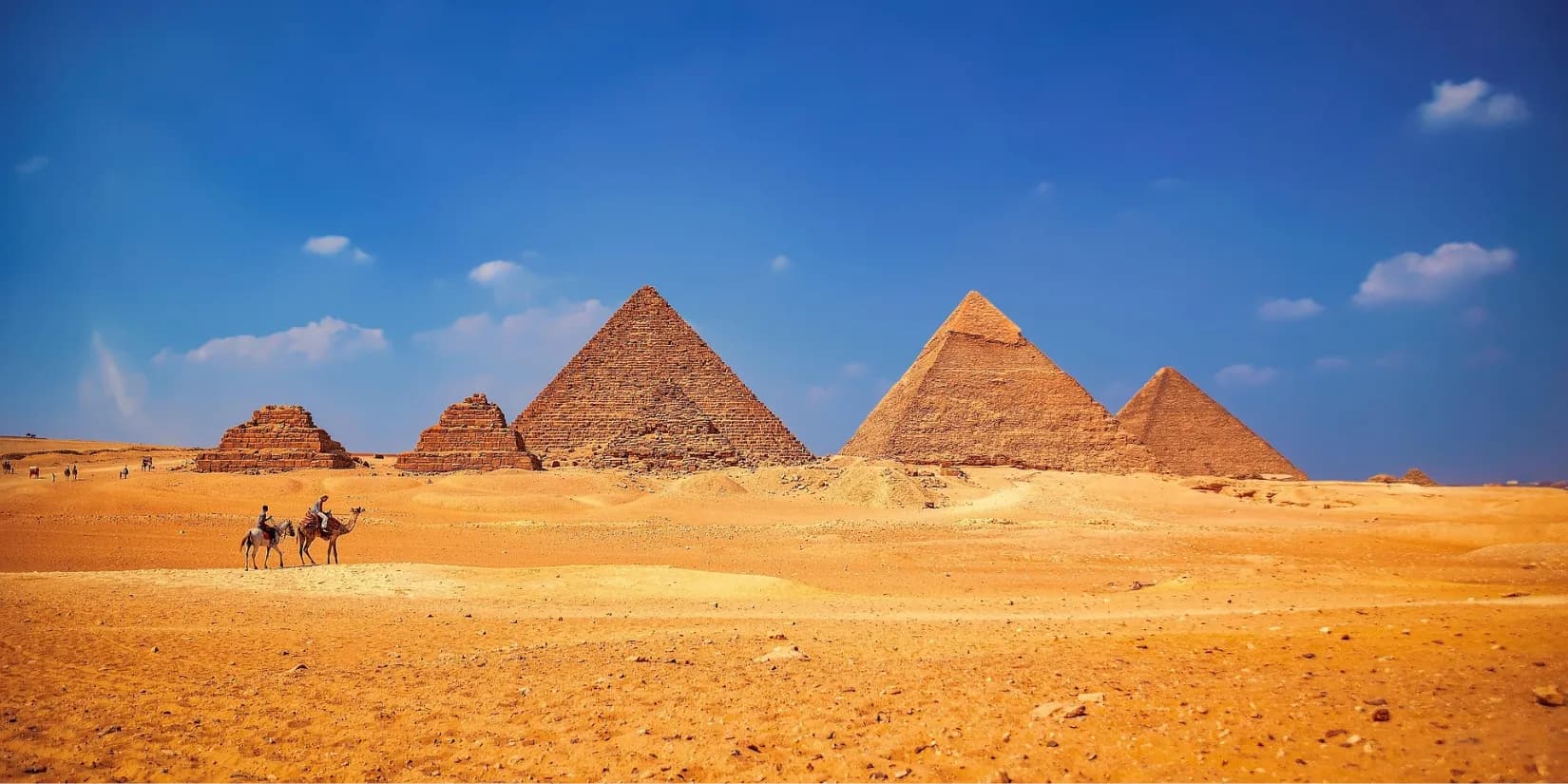
Most people picture the three great ones at Giza and leave it at that. In reality, Egypt has more than 100 pyramids scattered across the desert.
But the actual number is far higher. By most estimates, there are more than 130 pyramids scattered across the country, built over different dynasties and centuries. And archaeologists suspect that number may still grow as new sites are uncovered and studied.
Why so many were constructed in the first place is still debated. Many of them belong to earlier dynasties and vary widely in size and design. Some are partially ruined today, while others remain remarkably intact. This broader picture is essential to understanding the history of Egyptian pyramids, because the famous pyramids at Giza were actually part of a much longer architectural evolution.
3. The Oldest Pyramid Has A Different Design…
Long before the really smooth pyramids at Giza appeared, Egyptian builders experimented with different designs.
The Step Pyramid of Djoser, built around 2630 BC in Saqqara, is widely considered the oldest Egyptian pyramid. Instead of smooth sides, it consists of stacked stone layers that resemble giant steps. Designed by the architect Imhotep, it marked the beginning of pyramid construction and remains one of the most important milestones in the history of Egyptian pyramids.
4. Some Stones Weigh More Than a Truck!
The pyramids were built with enormous building blocks, each weighing as much, if not more, than an average dump truck!
Many of the limestone blocks used in the pyramids weigh between 2 and 15 tonnes, and some granite stones used in the King’s Chamber of the Great Pyramid weigh over 70 tonnes! Moving these stones across desert terrain without modern cranes or vehicles remains one of the biggest mysteries about pyramids that historians continue to debate.
If you’d like to see how these legendary monuments fit into the bigger picture, the 10-Day Voyage Through Sands and Sea journey by Cox & Kings ties together the pyramids, a scenic Nile cruise, and a relaxing finish by the Red Sea.
5. The Pyramids Once Shone Bright Like A Diamond
Today the pyramids appear sandy and rough, as a part of the desert landscape. But originally they were covered in polished white limestone casing stones. These stones reflected sunlight so intensely that the pyramids could be seen from miles away, almost glowing against the horizon.
Some ancient descriptions even suggest they shimmered so brightly that they looked like giant geometric mirrors in the sun…
6. The Great Pyramid Align With the Stars?
The sides of the Great Pyramid, for instance, point almost perfectly north, south, east, and west, with an error of barely 0.05 degrees. For something built more than 4,500 years ago, that level of accuracy is astonishing.
One theory suggests the ancient Egyptians used the stars themselves as a guide. By observing circumpolar constellations like the Big Dipper and the Little Dipper, builders may have been able to determine true north with surprising precision. These stars circle the North Pole and are visible throughout the year, making them reliable markers in the night sky.
Another idea, often called the Orion Correlation Theory, proposes something even more poetic. According to this theory, the three pyramids at Giza were positioned to mirror the three stars of Orion’s Belt. Since the god Osiris was associated with the constellation Orion in Egyptian mythology, some researchers believe the layout may have symbolised a connection between the pharaohs and the afterlife.
Whether the pyramids were aligned using circumpolar stars, inspired by Orion, or guided by some method is something we still don’t fully understand, but one thing is clear: the builders were paying very close attention to the sky above them.
7. The Iconic Sphinx Was Once Colourful
Today, the Great Sphinx looks like a weathered block of pale stone. But it probably didn’t always look that way. Traces of pigment discovered on the statue suggest the Sphinx may once have been painted in bright colours, including shades of red and blue!
Researchers have even found residues of red pigment on parts of the face, which hints that the statue might have been far more colourful than the muted sand-coloured figure we see today.
Some scholars also believe the monument may have gone through several restorations over the centuries, almost like the ancient world giving it the occasional facelift. Whatever the case, the Sphinx we see today is likely only a very faded version of what once stood guard over the pyramids.
For a classic first introduction to Egypt, explore this Egypt Pyramids & Nile Cultural Tour by Cox & Kings brings together two nights in Cairo exploring the pyramids with three unforgettable nights sailing along the Nile.
.webp)
8. The Builders Were Skilled Workers, Not Slaves
For decades, popular culture repeated the idea that slaves built the pyramids. Did they not?
Evidence like tools from workers’ villages near the pyramids indicates the structures were built by skilled labourers and craftsmen, close to 50,000 of them, who were organised into teams and likely paid for their work. This discovery changed much of what we thought we knew about the people behind these monuments.
9. Pyramid Construction Took… Decades
According to some estimates, it took just 23 years to build the Great Pyramid of Giza. To put that into perspective, St. Peter’s Basilica in Rome took over 120 years to complete, even with far more advanced tools and engineering knowledge. Considering the technology available at the time, it remains one of the most impressive construction achievements in human history.
10. The Pyramids Contain Hidden Passages
Inside the pyramids are networks of corridors, chambers, and narrow shafts that continue to fascinate archaeologists. Some passages were designed for rituals, while others may have been intended to protect burial chambers.
Even today, new scanning technologies are discovering hidden voids and unexplored spaces within the structures.These discoveries keep adding new layers of information about Egyptian pyramids even thousands of years after they were built.
11. The Dead Were Buried With Their Treasures…
Ancient Egyptians were, quite frankly, a little obsessed with the afterlife. Pharaohs were buried inside pyramids with everything they might need on the other side: jewellery, furniture, food, statues, and sacred texts.
The thinking was simple. If you were going to spend eternity somewhere, you might as well arrive prepared… preferably with your valuables.
12. The Pyramid Texts Are the Oldest Religious Writings!
Some pyramids contain inscriptions known as Pyramid Texts, those of which are considered the oldest known religious writings in the world!
These texts were carved directly into the walls of burial chambers and were meant to guide the pharaoh safely into the afterlife.
13. Climbing the Pyramids Is Now Illegal
At one point, visitors could climb the pyramids themselves. But today it’s strictly forbidden. The Egyptian government banned climbing the pyramids to preserve the monuments and protect visitors from accidents. Considering the steep slopes and massive stone blocks, it’s probably for the best…
14. A Sultan Even Tried to Destroy a Pyramid
In the 12th century, Sultan Al-Aziz Uthman attempted to dismantle the Pyramid of Menkaure.
His workers tried removing stones from the structure but soon realised the task was nearly impossible. The sheer size and weight of the stones made demolition far more difficult than expected, and the effort was eventually abandoned.
15. The Pyramids Still Aren’t Done With Their Secrets
Just when you think we’ve figured them out, the pyramids remind us that we probably haven’t. Despite centuries of research, excavation, and scanning, they still manage to keep a few surprises hidden.
In fact, fairly recently, researchers discovered a large unexplored chamber inside the Great Pyramid of Giza using a technique borrowed from particle physics called muon scanning. By tracking cosmic particles that pass through stone, scientists were able to detect a hidden void roughly 100 feet long deep inside the structure.
What makes it even more intriguing is that this space doesn’t appear to have been disturbed by ancient tomb raiders, meaning whatever purpose it once served remains completely unknown.
So while we’ve uncovered plenty of facts about Egyptian pyramids over the years, it’s safe to say the monuments are still holding on to a few of their biggest secrets… and it looks like they’re not in any hurry to give them up.
The History of the Pyramids of Giza
The Pyramids of Giza were built during the Old Kingdom of ancient Egypt, around 2600–2500 BC, during the Fourth Dynasty. The three main pyramids were constructed for the pharaohs Khufu, Khafre, and Menkaure.
The largest, the Great Pyramid of Khufu, contains roughly 2.3 million stone blocks and originally stood over 146 metres tall. Inside are chambers, shafts, and corridors designed to protect the king’s burial chamber deep within the structure.
What’s certain is that the pyramids required extraordinary organisation, engineering, and manpower. More than four thousand years later, they remain the only surviving wonder of the ancient world and one of humanity’s most enduring achievements!
If the pyramids have officially sent your curiosity into overdrive, connect with travel experts at Cox & Kings and plan a personalised journey that lets you stand in front of these ancient giants yourself.
Getting From Cairo to the Pyramids
For most travellers, visiting the pyramids begins with a short journey from Cairo to the pyramids at Giza, roughly 20 kilometres away. Somewhere along the way the buildings thin out, the traffic eases, and the desert starts to take over, and there you’ll see them, and this time, not as tiny as they looked on your phones…
To explore more journeys across the world, discover expertly designed international tours by Cox & Kings today!