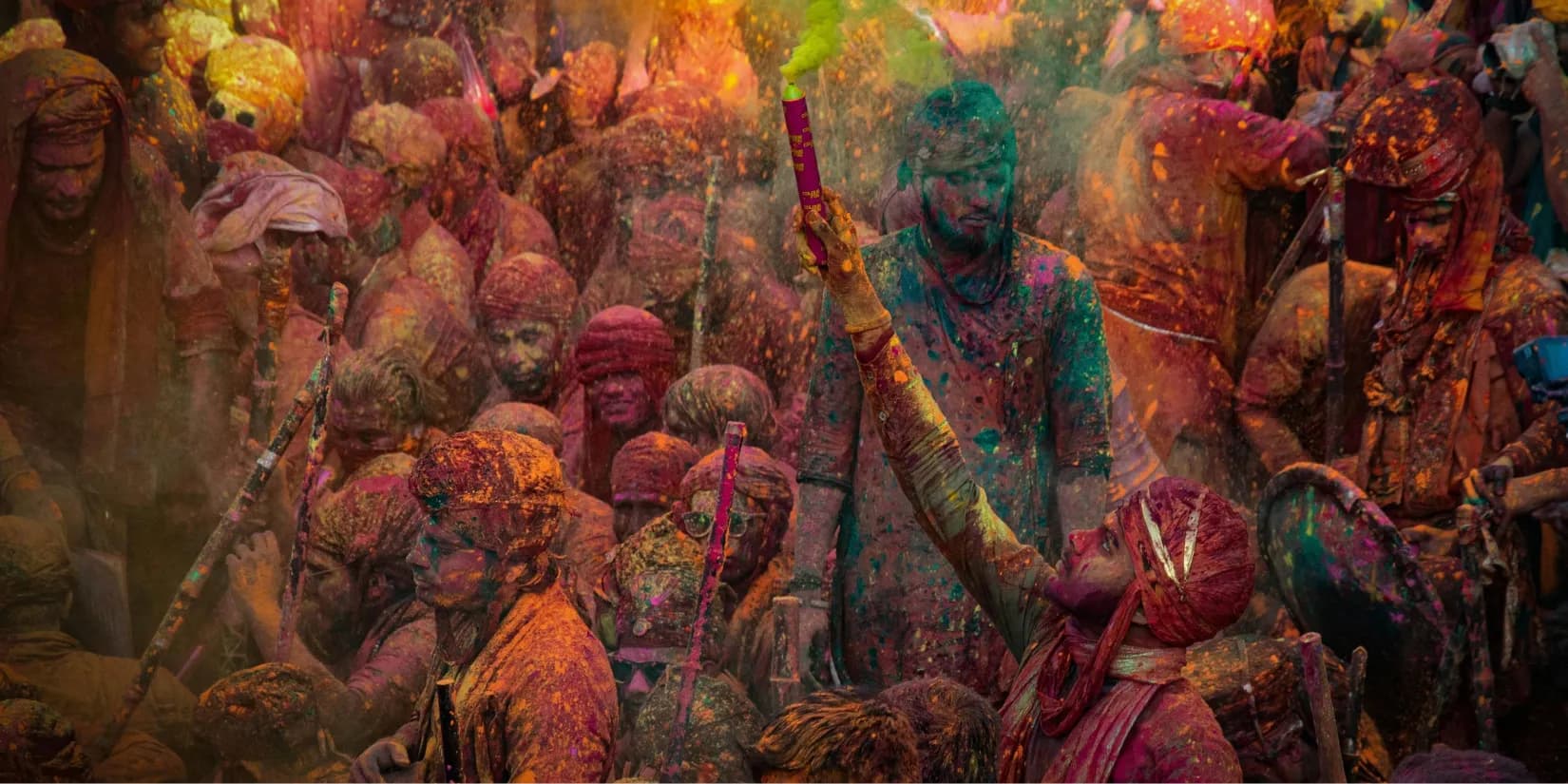
Look around, and you’ll notice how strangely colours are slipping out of everyday lives. Even something as simple as cars, that once came in bright reds, sunny yellows, and ocean blues, are all washed in blacks, greys, and silvers now. Streets are lined with steel and glass that reflect shades of grey, wardrobes have grown safer and muted, and somewhere along the way, without noticing, life started to lose its truly colourful days…
And just then, almost on cue, every year, comes a festival that refuses to let that happen!
The festival of colours and joy is here again, and the whole country waits to paint itself in red, green and purple. As the Holi fever heightens, we pick some of the best places to celebrate holi in India which showcase the festival in uniquely beautiful ways. Whether you're chasing heritage, music, or all-out colour fight, these are some of India’s most stunning places to celebrate holi in 2026.
Coastal Festivities & Rangapanchami In Mumbai
Mumbai is known to celebrate every festival as its own, and Holi is no exception! Here, Holi festivities begin with Shimga, where evil is burned in a bonfire, followed by Rangapanchami, a riot of colors, water balloons, and pichkaris…
The streets get colourful from gregarious children pelting water balloons and colour on people, and on Holi eve, a grand bonfire is lit, with coconuts tossed in to welcome spring. Among the more urban places to celebrate holi, Mumbai offers a high-energy festive atmosphere!
The Legendary Lathmar Traditions In Barsana
If a traditional Holi is what you have in mind, stop looking further; go to Braj Barsana in Uttar Pradesh. Here, women from Barsana playfully beat men from Nandgaon with sticks as the men try to fend them off with colors and water. This reenacts a mythical tale of Radha and Krishna, with Nandgaon’s men attempting to hoist a flag at Radha’s temple!
The celebrations continue the next day in Nandgaon, reversing the roles. The festivities are filled with Hori songs, adding to the lively spirit of Holi, making it one of the most culturally immersive places to celebrate holi.
The Devotional Celebrations of Vrindavan
Vrindavan, where Lord Krishna is believed to have grown up, celebrates Holi in its most authentic form. Festivities begin a week in advance, honoring Radha-Krishna with romantic fervor. Theatre troupes enact their legends, drawing entire villages to colourful roadside performances!
The celebrations at the Banke Bihari Temple are the heart of Holi celebrations. It starts with Holika Dahan, where a massive bonfire symbolizes the burning of negativity. The next day, Dhulendi, the temple is adorned anew as devotees sprinkle gulaal on the deity and each other. The celebrations continue with Lathmaar Holi and joyous Hori songs, making it one of the most spiritually significant places to celebrate holi.
Festivals are just the beginning. Explore more travel inspiration, cultural discoveries, and destination guides on our blogs station!
The Artistic Spring Traditions At Shantiniketan
While the entire country celebrates Holi in a boisterous manner, Shantiniketan, true to its name, celebrates the festival with serenity and peace, as Basantotsav. The festival heralds the season of spring and thus has boys & girls from the ashram sing melodious songs & perform elegant dances wearing yellow-coloured clothes.
The girls wear yellow/golden saris with garlands and the boys wear yellow kurta-pyjamas. The whole atmosphere becomes mildly scented with the fragrance of abeer. The Basantotsab has become a very important day of the Bangla calendar and attracts hordes of foreign tourists every year, making it one of the best places for holi if you prefer peaceful culture over high-energy celebrations.
Folk Dances & Cultural Holi At Purulia
Another cultural destination to celebrate Holi is Purulia in West Bengal. The three-day celebration is packed with a bunch of amazing folk performances such as the famous Chhau dance, Natua dance, Jhumur music and the wandering Baul musicians!
Holi is celebrated by smearing abeer on each other and partaking mahuo liquor. Folk artists from neighbouring districts also bring a distinct side to this festival which is celebrated near the Konshobti River at Deulghaata. The icons of Radha & Krishna are taken out in a palanquin for a procession that is accompanied by these folk singers.
Warrior Traditions During Hola Mohalla In Anandpur Sahib
The birthplace of Khalsa i.e. Sikh brotherhood, Anandpur Sahib is a pilgrimage destination for the Sikhs. The people here also celebrate Holi but in the most unimaginable way possible… Instead of colour and water, here you will witness a testosterone-fuelled Holi!
Hola Mohalla as it is called, is a tradition dating back to 1701, and was started by Guru Gobind Singh. On this day, Sikh Nihangs display their martial & warrior agility through a bevy of activities such as wrestling, mock sword fights, martial arts, mock-battles, ‘gatka’ i.e. military exercises and turban tying. This remains one of the most unique places to celebrate holi in India.
.webp)
The Royal Heritage Celebrations In Jaipur
In Jaipur, Holi is celebrated with pomp and ceremony and more so with a regal air befitting the royal history of Rajasthan. Traditionally, Jaipur hosted grand elephant processions, featuring ornate jewellery, decorated animals, folk dancers, camels and horses.
In recent years, however, elephant-based festivities have been significantly reduced due to growing animal welfare awareness. However, Jaipur continues to host stunning cultural performances, royal-style celebrations, and community festivities that still make it among the best places to celebrate holi while welcoming more responsible tourism practices.
Planning to celebrate Holi in any of these destinations? Explore our expertly curated journeys across India and time your travels to experience these beautiful celebrations at their most authentic!
Join Krishna-Inspired Festivities Across Gujarat
Most towns and cities in Gujarat celebrate Holi in the same gregarious manner. The day prior is celebrated with a contest of sorts to anoint the Holi King of the year. Known for its legends of Lord Krishna when he was a child, Gujarat enacts those scenes from the folklore of Baal Krishna, by forming human pyramids who then try to break a pot containing buttermilk, suspended from a height!
Onlookers keep spraying water on the boys who form this pyramid. The winner is anointed as Holi King for that year. After this joyous contest, a Holika is made with fire brought from the local Goddess’ temple. Offerings of corn, raw mango, sugar figurines and condensed milk is made to the Holika, following which people apply red vermilion to each other’s forehead.
Little girls create idols of ‘Gauri’ from the ashes of the Holika. The next day of Dhuleti is spent boisterously with colours and water. In fact nowadays, rain dances are becoming a permanent feature of Dhuletis…
Experience Musical Kumaoni Holi Traditions In Uttarakhand
Holi here is all about music. It plays a pertinent part in Uttarakhand which is called Kumaoni Holi. Traditionally speaking, Kumaoni Holi goes on for two months! It incorporates Baithki Holi, Khari Holi and Mahila Holi. In Baithki Holi, Holi singers gather in temples to sing classical songs that portray the legend of Lord Krishna.
Khari Holi follows the Baithki Holi and comprises folk singers who dress in a particular way and go around the villages singing joyful folk songs. Mahila Holi comprises only women, singing the traditional Horis. These celebrations culminate into a Cheer Bandhan (bonfire), fifteen days prior to Dhulendi.
Playful games are played to steal each other’s ‘cheer’. The next day is the Dhulendi/Chharadi, in which people smear each other with colours made from natural ingredients. The celebrations end with a ritualistic Shubh Kamna prayer, making this one of the most culturally immersive places to celebrate holi.
The Spiritual & Symbolic Celebrations In Tamil Nadu
The southern coastal state celebrates Holi in a totally different mood. Contradictory to the merrymaking that accompanies Holi celebrations in North India, Tamil Nadu and other Southern regions observe Holi as an ode to the God of Love Kamadev and his consort Rati.
It is an ironic celebration here. Whilst the festival is heralded as a celebration of love, it also contains rituals that seek to mark the victory of spiritual bliss over romantic desires. The festival is addressed by different names such as Kama Dahanam and Kama Vilas and entails singing of sad folk songs that narrate the legend of Rati and Kamadev.
A symbolic bonfire is lit on the day prior to Holi, to signify overcoming romantic desires as well as negativities in general. The next day is a play of colours, but yet not as boisterous as in North India, making it among the lesser-known yet meaningful places to celebrate holi.
Discover more holidays through India and across the world with expertly crafted journeys by Cox & Kings, where every itinerary is designed to bring you closer to culture, celebration, and stunning travel experiences.